
Issue #13: The most enjoyable and useful Mathematical books of all time
…every smart person should read (even if you struggle with math anxiety)

A question is often asked: Should I read books to become better at mathematics?
Usually, the answer is yes, and not because these books drill formulas, propositions, theorems, and lemmas into your head, but because the authors wrote them at a moment when their insight, clarity, and passion were at their peak.
The only better option would be to learn directly from them, which is rarely possible.
Yet many people avoid math books altogether, assuming they are dry, inaccessible, or intimidating. However, the books in this list are rich in narrative, humor, history, intuition, and humanity.
If you read them, you’ll immediately find yourself ahead of the crowd, not because you “know more math,” but because you understand it more deeply and joyfully.
Over the years, I’ve developed a routine of reading widely across mathematical literature: from theoretical books to books about the history of mathematics and books that explain math on an intuitive level with a humorous approach.
Combined with recommendations from peers and curated lists from mathematicians and educators, I compiled the most enjoyable mathematical books ever written: books that consistently change how people feel about math.
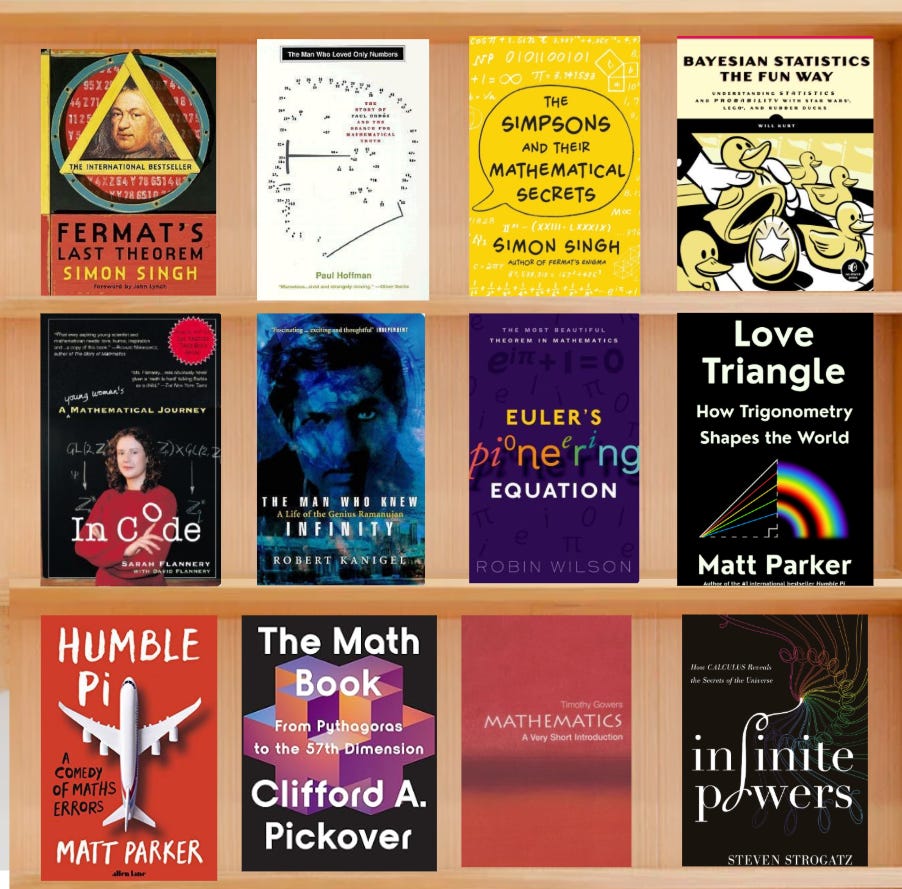
Bookshelf with enjoyable mathematical books
A short disclaimer: reading these books won’t instantly make you better at math.
That requires months and even years of practice. But these books will give you insight, intuition, and perspective, and help you avoid common misconceptions that plague self-learners.
This list is necessarily incomplete; there are great new books that appear every year, but these are timeless, impactful, and universally beloved, and I’ve shared this list with thousands of my students over the past 5 years, who loved it.
They are mostly beginner-friendly in the sense that you don’t need an advanced math background to enjoy them.
1. Fermat’s Last Theorem
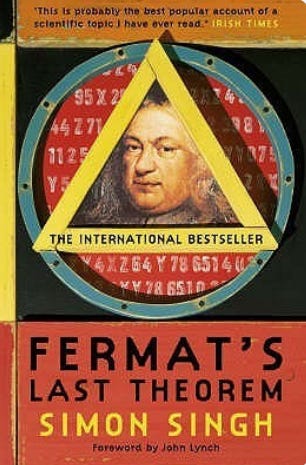
It is one of the most interesting stories in math history that lasted over three hundred years. The author, Simon Singh, follows the mathematicians who tried to prove it, culminating in Andrew Wiles’s deeply personal and hard-won breakthrough after decades of dedication. Singh explains complex ideas with clarity and excitement, making the reader feel the emotional weight behind every attempt and failure. It is an inspiring read for anyone who appreciates the beauty and emotional depth of mathematics.
2. The Man Who Loved Only Numbers: The Story of Paul Erdős and the Search for Mathematical Truth
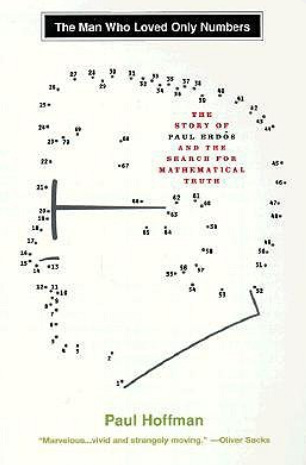
This book is a biography of Paul Erdős, one of my favorite mathematicians and probably the most important mathematician of the 20th century. He collaborated with over 500 different people on over 1400 published papers, and every researcher now talks about their “Erdös number”. The author Paul Hoffman shows Erdős’s eccentric behavior, relentless collaboration, and childlike enthusiasm for solving math problems. The book is filled with charming stories about this eccentric and kid man. Along the way, it introduces major ideas in number theory and combinatorics in an accessible way.
3. The Simpsons and Their Mathematical Secrets
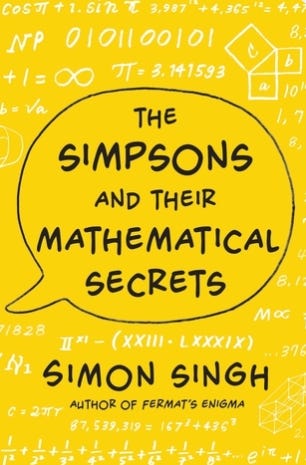
In this book, Simon Singh uncovers the surprising amount of sophisticated mathematics hidden in cartoons, The Simpsons (my favorite animated sitcom), and Futurama. Many of the show’s writers hold advanced degrees in mathematics, and they slipped everything from group theory to Fermat’s Last Theorem into various episodes. I recommend this book as a fun way to explore these concepts without the need of having a mathematical background. It’s a delightful read for anyone who enjoys math mixed with cartoons.
4. Bayesian Statistics the Fun Way: Understanding Statistics and Probability with Star Wars, LEGO, and Rubber Ducks
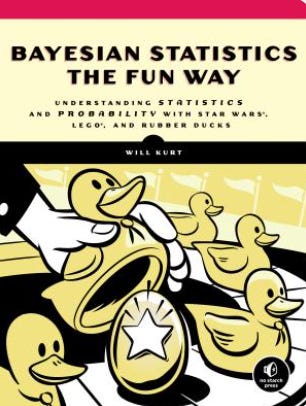
This is an excellent book for getting an intuitive and gentle introduction to Bayesian thinking, using playful examples. Rather than focusing on formal proofs, the book emphasizes how to reason under uncertainty using simple probability updates. Each chapter builds on everyday scenarios to demonstrate how beliefs change with new evidence. The writing is friendly and humorous, lowering the barrier to a topic often viewed as difficult. It’s one of the easiest entry points into Bayesian reasoning available today.
5. In Code: A Mathematical Journey
It is the easiest read of all the books I’ve listed here, but the most personal one. This part-memoir, part-math-journey follows a young girl, Sarah Flannery’s rise from a curious Irish schoolgirl to an award-winning young mathematician. The story centers around her work on a new cryptographic algorithm that captured global attention. Sarah and her father conversationally explain the mathematical ideas, making even complex topics feel approachable. Throughout the book, you see how encouragement, curiosity, and problem-solving shape a young mathematician’s life. It’s an inspiring read for students and adults alike.
6. The Man Who Knew Infinity
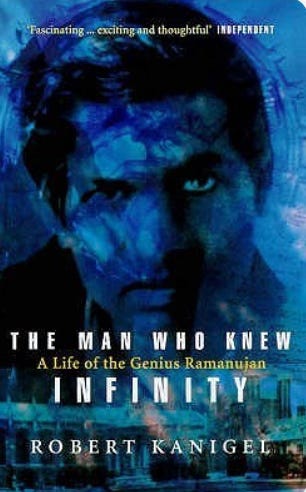
This book is a biography that tells the life story of Srinivasa Ramanujan, an intuitive mathematical genius who grew up in poverty in India before astonishing Cambridge mathematicians with his originality. It explores both his remarkable discoveries and the cultural and personal struggles he faced while living abroad. The book also highlights the unlikely but powerful partnership between Ramanujan and G.H. Hardy. It’s an unforgettable account of brilliance against the odds.
7. Euler’s Pioneering Equation: The most beautiful theorem in mathematics
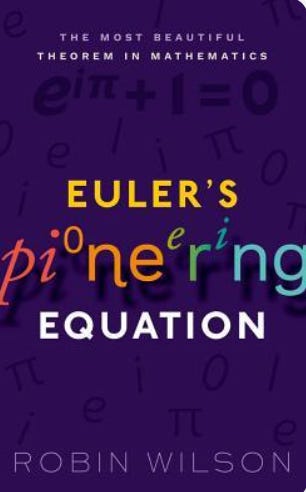
This short, elegant book explores Euler’s equation: e^(iπ) + 1 = 0 and why it’s considered one of the most beautiful and important equations in mathematics. It devotes us a chapter to five of the most fundamental numbers in mathematics: e, i, π, 1, and 0, before explaining the equation itself. Step by step, you get introduced to counting systems, types of numbers, geometry, infinite series, and even complex numbers. The book includes helpful illustrations and biographical context that enrich the narrative. It’s a concise but uplifting celebration of mathematical beauty.
8. Love Triangle: How Trigonometry Shapes the World
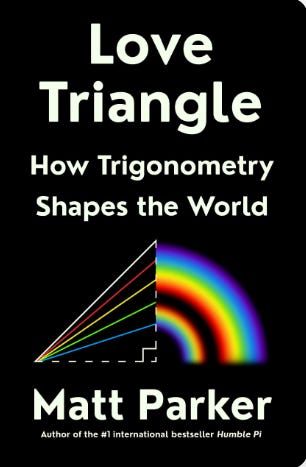
This book combines humor, storytelling, and clever metaphors in its exploration of trigonometry’s hidden presence in daily life. From GPS systems to sound waves to architectural design, he reveals how triangles quietly underpin our modern world. The author Mark Parker explains the math with clarity and joy, turning topics like sine waves and radians into inviting ideas rather than classroom pain points. The book includes hands-on examples that keep readers entertained. It’s perfect for anyone who wants to rediscover trigonometry in a fun, practical way.
9. Humble Pi
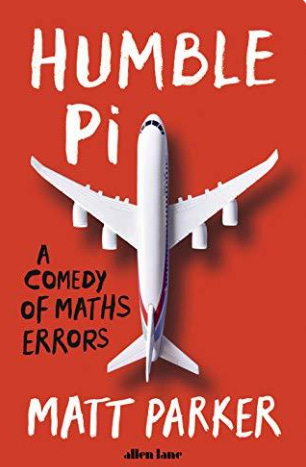
Another great and humorous book by the same author covers a comedic tour through mathematical disasters, highlighting what happens when numbers go wrong in the real world. Parker recounts cases of engineering failures, financial catastrophes, and measurement mix-ups, all caused by seemingly small mathematical oversights. His storytelling is lively and humorous, but the lessons are sobering: math errors can be expensive or dangerous. Each chapter uses real incidents to show why mathematical literacy matters beyond school. It’s equal parts educational and entertaining.
10. The Math Book: From Pythagoras to the 57th Dimension, 250 Milestones in the History of Mathematics
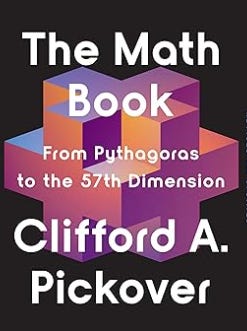
This book presents 250 remarkable mathematical milestones, each in a short, visually engaging entry. Spanning from ancient civilizations to modern theoretical physics, the book highlights major breakthroughs, curious oddities, and profound insights. Every page pairs striking imagery with a concise explanation of the concept. The format makes it easy to browse, dip into, or read chronologically. It’s a beautifully designed celebration of mathematical creativity across cultures and centuries.
11. Mathematics: A Very Short Introduction
In this book, Timothy Gowers delivers the essence of mathematical thinking into a compact, highly readable volume. Instead of focusing on specific formulas or techniques, he explains how mathematicians reason, generalize, and discover structure. The book introduces key ideas from basic arithmetic, logic, geometry, number theory, and non-Euclidean geometries in a way that even beginners can follow. This is probably one of the best starting points for understanding what mathematics truly is.
12. Infinite Powers: How Calculus Reveals the Secrets of the Universe
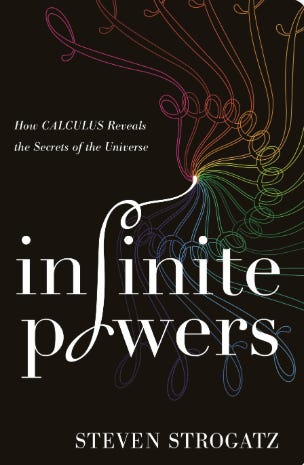
The book tells the story of calculus as the tool humanity invented to understand motion, change, and the infinite. He guides readers through the historical breakthroughs that led to the development of calculus, including the ideas of Archimedes, Newton, and Leibniz. The explanations are intuitive and visual, focusing on concepts rather than heavy notation. Strogatz connects calculus to modern science, medicine, technology, and everyday life. It’s an inspiring, beautifully written introduction to one of mathematics’ most powerful ideas.
Honorable Mentions
In addition to the top mathematical books above, many excellent works didn’t make the main list but are still highly recommended:
Jordan Ellenberg: How Not to Be Wrong
An insightful exploration of how mathematical reasoning underpins everyday decisions, politics, economics, and science.
Steven Strogatz: The Joy of x
The guide through the elements of mathematics, covering six parts: Numbers, Relationships, Shapes, Change, Data, and Frontiers.
G. H. Hardy: A Mathematician’s Apology
A great short book on the beauty and purpose of pure mathematics.
Marcus du Sautoy: The Music of the Primes
The interesting history behind the Riemann Hypothesis and those who explored it.
Thanks for reading this week’s issue.
If you’re here, let me know if you’ve read one of the books I’ve recommended in the comments below (or leave your favorite mathematical book)
Until next week’s issue, keep learning, keep building, and keep thinking like a mathematician.
-Terezija