

Someone is knocking at your door at 9 pm Tuesday evening. You open the door and on the doorstep is a small elderly man holding one suitcase. You have never met him be. He announces: “My brain is open.” , walks in, and asks: “What you are working on?”
For four decades this happened to mathematicians all over the world, and almost none of them turned him away. Because the man at the door was Paul Erdős, and a visit from him meant that within a few days you might have a new conjecture, theorem, or a co-authored paper.
I wrote this issue is to cover how he worked, why the arrangement produced so much, and what it says about a myth that mathematics is done by introverted people in quiet rooms.
A career with no fixed address
Paul Erdős was born in Budapest in 1913. to two mathematics teachers Anna and Lajos. His circumstances were hard from the start. While his mother was in hospital giving birth to him, his two sisters died of scarlet fever. He grew up an only child under the close protection of a mother who, for homeschooled him for years.
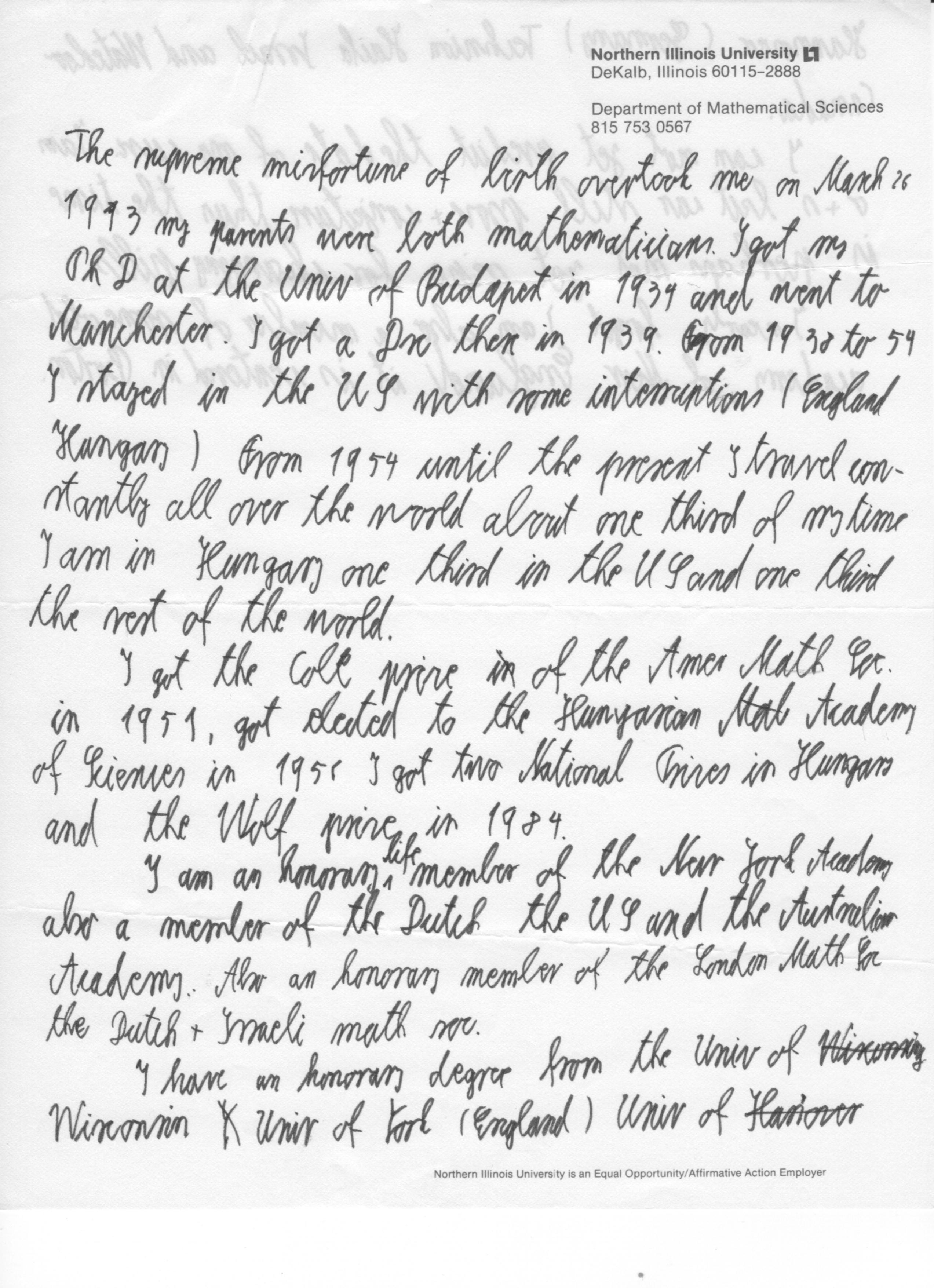
Erdős biography in his words
His parents taught him mathematics from early childhood, so by the time he was 4 years old, he was doing calculations with negative numbers, and multiplying 3-digit numbers. He earned his doctorate in Budapest at 21, then took a fellowship in England, Manchester. Being Jewish and Hungarian in the late 1930s, he did’t returned home. Most of his family who stayed in Hungary did not survive the war.
What followed was one of the interesting working lives in the history of science. Erdős never took a permanent academic post. He never married and had no children.
He owned almost nothing beyond what fitted in a single case, and he could not drive, cook, or reliably operate household objects.
Paul moved between universities, conferences, and colleagues’ spare rooms, sometimes changing country every few weeks, for something close to fifty years.
He funded this by lecturing, and gave most of what he earned away, to students, to relatives, to people who needed it more, and as cash prizes for unsolved problems he wanted answered.
He also invented and spoke his own dialect. Children were epsilons, named after the mathematical symbol for a small quantity. Alcohol was poison. Music was noise. To do mathematics was to preach; to give a lecture was to sermonise. When someone died he sad they had left; when they stopped doing mathematics they had, in his vocabulary, died.
He labeled mathematical proofs that he found particularly pleasing as being from “The Book,” an imaginary, infinite manuscript containing the best theorems. Erdös graduated with his PhD in 1934.
// When asked why are numbers beautiful?
It’s like asking why is Ludwig van Beethoven’s Ninth Symphony beautiful. If you don't see why, someone can't tell you. I know numbers are beautiful. If they aren't beautiful, nothing is.”
― Paul Erdos
Paul found some mathematical proofs elegant and valuable, so he labeled them as being from “The Book”, a God’s imaginary volume containing the most elegant proof of every theorem. The highest compliment for a proof was that it came straight from The Book.
My brain is open
The phrase was his greeting.
Paul Erdős did not arrive at a colleague’s house with his own agenda. He arrived and asked what they were stuck on. Then he worked on their problem, in their kitchen, for as long as it took or until it was clearly hopeless, at which point he moved to the next house.
This inverts how most careers operate. The standard model is to defend a territory: your problem, your result, your name on it. He treated problems as common property and himself as a travelling resource. The result was around 1,500 papers, more than any mathematician in history, and roughly 500 distinct co-authors.
That collaboration graph became dense enough that mathematicians invented a joke metric for it.
Your Erdős number is your distance from him in the network of co-authorship: his direct collaborators have 1, their collaborators have 2, and so on. Several hundred people have an Erdős number of 1, and a large share of working mathematicians can reach him within four or five steps.
The joke is real mathematics, incidentally. It is a shortest-path calculation on a graph, which is exactly the structure Euler invented in 1736.
Notice what the Erdős number actually measures. It is not a measure of talent. It is a measure of how connected the field is, and the reason the numbers are so small is that mathematicians talk to each other constantly. The lone genius is not just a flattering myth. It is a description of a network that does not exist.
The other half of his method was problem-posing. Erdős generated conjectures continuously and gave them away, often with a cash prize attached, scaled to how hard he judged them: a few dollars for something tricky, thousands for a problem he expected to outlive him. Some of those prizes are still open and are now paid by his estate and colleagues.
People outside the math circles called this eccentricity. It is a distribution. A problem written in his notebook helps nobody. A problem circulating with a price on it recruits strangers into the work, they become collaborators, and sometimes colleagues.
“A mathematician is a device for turning coffee into theorems”
― Paul Erdos
This quote is widely attributed to Erdős, though his colleague Alfréd Rényi seems to have said it first. Erdős certainly lived it: he worked punishing hours, sustained by coffee and, for much of his later life, stimulants. The line is funnier than the reality, which cost him.
Small questions, enormous consequences
Erdős worked mainly in number theory, combinatorics, and graph theory: fields where problems can be stated in a sentence and resist solution for decades. He avoided building grand theories. He preferred sharp, concrete questions.
Three of his contributions matter for anyone working near computing.
The probabilistic method
This is his most important methodological legacy. To prove that an object with some property exists, do not construct it. Instead, choose an object at random and show the probability that it has the property is greater than zero. If it is, the object must exist, even though you have not produced a single example.
That idea now runs through theoretical computer science: randomised algorithms, hashing analysis, error-correcting code constructions, and complexity theory all use it.
Random graph theory
With Alfréd Rényi, he studied what happens when you build a network by adding edges at random. Their central discovery was that such networks undergo sharp phase transition: below a critical threshold, all connected components are small; above it, a giant component containing a positive fraction of the vertices emerges.
That threshold behaviour is the mathematical backbone on epidemics, network resilience, social contagion, and percolation. The Erdős-Rényi model is where every student of network science still starts.
Ramsey theory
Roughly: complete disorder is impossible. In any sufficiently large structure, some order must appear whether you want it or not. Colour the connections between six people by whether they are friends or strangers, and you are guaranteed a group of three who are mutually one or the other. You cannot arrange it otherwise.
This is a useful to be aware of in an era of pattern-hunting. Some patterns in large datasets are guaranteed by size alone, and finding them tells you nothing about the world.
5 habits worth stealing

Erdős working (and drinking coffee)
Treat every conversation as a possible collaboration
Erdős’s output was a function of how many rooms he walked into. He had no lab, no funding, and no institution. He had access to other people’s problems, which turned out to be enough.
Ask small, sharp questions
He rarely chased grand unifying theories. He posed hundreds of precise, well-defined problems. A precise small question can be attacked, shared, and solved. A vague large one mostly generates opinions.
Work on what is in front of you
He arrived and asked what you were stuck on, then worked on that. No territory, no positioning. Contribution beat ownership, and the contributions compounded.
Give the credit away
He gave away prize money and co-authorship freely. It cost him little and it made him the person everyone wanted to work with, which is how he got access to 500 collaborators’ hardest problems.
Accept that volume is part of quality
Not all 1,500 papers were important, and he knew it. Enough were. Producing a great deal and letting the field sort it is a different strategy from striving for perfection. For example, Gauss’s opposite approach left decades of work sitting unpublished in a drawer.
If I could describe Erdős in 1 sentence it would be:
He owned nothing and published everything.
What the model cost
It would be dishonest to present this as a lifestyle to copy wholesale.
Erdős depended completely on other people. Colleagues and their families housed him, fed him, did his laundry, and managed his affairs, sometimes for weeks. His productivity had a support structure, and much of that structure was unpaid domestic labour by people whose names are not on the papers.
He also relied on amphetamines for decades. When a friend bet him he could not stop for a month, he stopped, won the bet, and then complained that mathematics had been set back a month because he had sat staring at blank paper. Then he resumed. That is not a charming anecdote so much as a description of dependence.
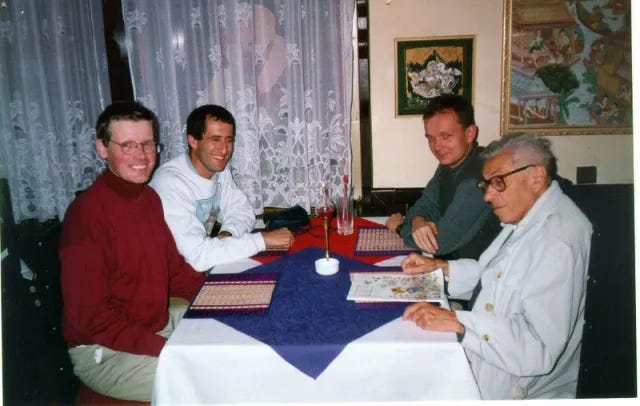
Erdős having dinner with his friends, few days before he permanently left
He died in 1996, at 83, at a conference in Warsaw. He had been doing mathematics that day, which is the ending he wanted.
You shouldn’t remember Erdős as a man who owned just a suitcase or the stimulants. It is his altruism: problems held in common, credit given freely, and giving away nearly all his prize money and lecture fees to students and mathematicians.
Why this matters now
The Erdős model looks unusual for a 20th-century mathematician. It looks completely ordinary for a modern open-source or research community.
Public repositories with shared issue trackers, preprints posted before review, benchmark results published for anyone to beat, the Polymath projects proving theorems through open online collaboration: all of it is the same arrangement. Problems in common, contribution over territory, credit distributed rather than hoarded.
Erdős believed your leverage is not only what you know; it is how many people bring you their problems.
He had no institution, no salary, and no address, and he became the most connected node in 20th-century mathematics by making himself useful to whoever opened the door.
References
Further references can be found in:
The Man Who Loved Only Numbers, Paul Hoffman, Grand Central Publishing, 1998
My Brain Is Open: The Mathematical Journeys of Paul Erdős, Bruce Schechter, Simon & Schuster, 1998
On the Evolution of Random Graphs, Paul Erdős & Alfréd Rényi, Publications of the Mathematical Institute of the Hungarian Academy of Sciences, 1960
Proofs from THE BOOK, Martin Aigner & Günter Ziegler · Springer, 1998
The Erdős Number Project, Jerrold Grossman et al. ,Oakland University
P.S. Thank you for reading this far
That alone puts you in rare company: most people scroll past anything that asks them to think slowly.
The fact that you’re here suggests you already value the kind of thinking this newsletter is about. Share it with someone who values it too. Those people are worth finding.
Comment below and share the newsletter/ issue if you think it is relevant!
Feel free to also follow me on LinkedIn (very active), Instagram(not so active) or X (not so active).
Until next week’s issue, keep learning, keep building, and keep thinking like a mathematician.
-Terezija
Thanks for reading Math Mindset!
Subscribe for free to receive new posts and support my work.
The best ideas come over beer.
That type of homeless lifestyle and great productivity were not his alone. Paul Reps, the swiss-born painter-poet was almost identical and Daichi the Japanese monk-poet was the same. Like in Van Loon's Lives, I would love to have all three as dinner guests.. the conversation would be fascinating.